


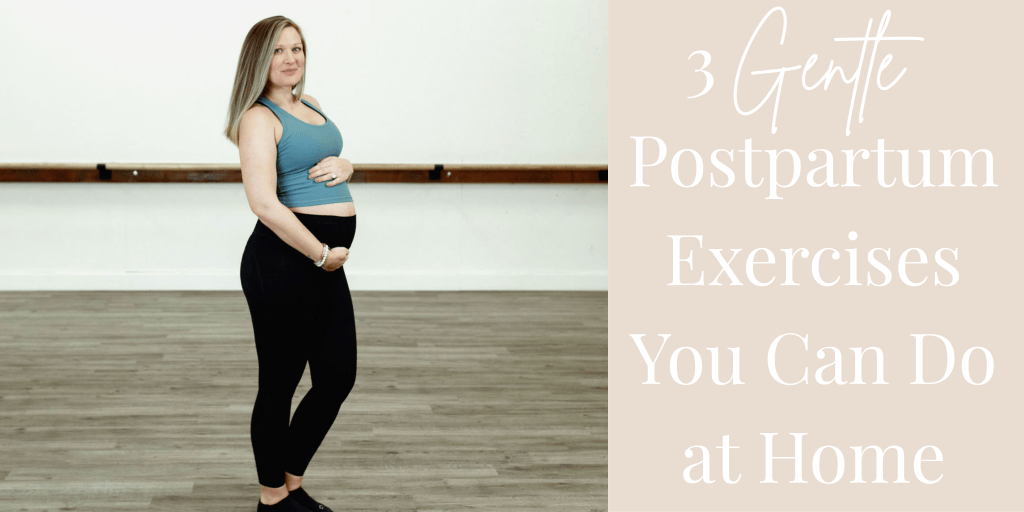
First, take a deep breath. You just grew and gave birth to an entire human being. That is absolutely extraordinary! Your body has done something incredible, and right now, it deserves just as much tenderness and care as your brand-new baby does.
The first days and weeks after birth are not the time to “bounce back.” We’re happy for you, Karen, but it’s not a race to get your body back to where it was before pregnancy. Your body is healing, your hormones are shifting, your pelvic floor and abdominal muscles are recovering, and you are learning how to care for a tiny person while probably running on very little sleep.
So when we talk about postpartum movement, think gentle, slow and restorative. Movement during this season isn’t about burning calories or getting stronger as quickly as possible. It’s about reconnecting with your body, encouraging mobility, supporting your recovering muscles and simply reminding yourself that your body is still yours. Health guidance generally supports beginning gentle movement gradually after birth, as long as you feel ready and there haven’t been complications that require you to wait. Walking, gentle strengthening and mobility work can all be part of those early days if your doctor has cleared you to begin gentle movement.
Before you begin think: the gentler, the better
These exercises are meant to be low-intensity movements, not a postpartum workout. If something hurts, stop. If you feel pulling, pressure, increased bleeding, dizziness, or anything that doesn’t feel right, pause and check in with your healthcare provider. If you’ve had a C-section, significant tearing, extensive vaginal repair or another birth complication, ask your healthcare provider when these movements are appropriate for you and how they may need to be modified. Even movements that are gentle for one person may not be right for another person’s recovery. The best thing you can do for yourself right now is listen to your body.
1. Cat-Cow
Cat-cow is a simple movement where you slowly alternate between rounding and gently extending your spine.
Start on your hands and knees, with your hands underneath your shoulders and your knees underneath your hips (if getting down onto the floor isn’t comfortable yet, you can also modify this movement from a seated position). From a neutral position, slowly round your back toward the ceiling, allowing your head to relax down. Then, if it feels comfortable, slowly move in the opposite direction, letting your chest gently open and your belly move toward the floor. Keep the movement very small. You do not need to make a huge arch or get a dramatic stretch. In fact, in those early postpartum days, your version of cat-cow might barely move at all, and that’s completely okay.
Why it can feel good postpartum
Pregnancy and birth ask a lot of your back, pelvis and core. You may also find yourself spending hours feeding, holding, rocking and looking down at your baby. Cat-cow gives your spine a chance to move gently through different positions. It can help you reconnect with your posture and body awareness while gently moving the muscles around your back and abdomen.
Try 3–5 slow repetitions to start.
And remember: this isn’t about how far you can move. Move only as far as your body says yes.
2. Pelvic Tilts
Lie on your back with your knees bent and your feet resting comfortably on the floor or bed. Take a slow breath. Then gently rock your pelvis so that your lower back moves toward the surface underneath you. Hold for a few seconds, then slowly return to that neutral starting position. From there, tilt your pelvis forward creating an arch in your back away from the floor. Hold this for a few seconds before returning to a neutral position.
Why it can feel good postpartum
Your abdominal muscles, pelvis and pelvic floor have been through a tremendous amount of change during pregnancy and birth. Pelvic tilts offer a very gentle way to begin reconnecting with this area and gently strengthen the abdominal muscles without asking your body to perform a strenuous core exercise. They can also gently move and stretch the lower back and pelvis, which may feel especially nice if you’re experiencing stiffness or achiness.
Try 5 gentle repetitions to begin.
3. Happy Baby
Happy Baby is a gentle yoga pose traditionally done lying on your back, with your knees bent toward your chest and your feet lifted toward the ceiling. You can place your hands behind your thighs, calves or ankles rather than reaching for your feet, if need be. Let your knees open slightly wider than hip width, and allow your body to settle into the position.
Why it can feel good postpartum
Your hips and pelvis have spent months adapting to pregnancy and then moving through birth. Happy Baby can gently encourage mobility around the hips and pelvis while giving you a moment to slow down and breathe. And perhaps just as importantly, it can become a little reminder to release instead of brace. After birth, it’s easy to spend a lot of time holding tension in your shoulders, jaw, belly, hips and pelvic floor. A comfortable, supported position combined with slow breathing can help you become aware of that tension and soften it.
Try holding this stretch for 60-90 seconds.
Why Moving Again Matters — But So Does Rest
It can be tempting to think of postpartum movement as something you need to do to “get your body back.” But what if movement wasn’t about getting your old body back at all? What if it was just an act of caring for the body that just carried you and your baby through something enormous? Gentle physical activity can be a great way to support your energy, mood, sleep, cardiovascular fitness and muscle strength. It can also help relieve stress and may even help reduce symptoms of postpartum depression. But that doesn’t mean you need to jump into an “exercise routine.” In the beginning, movement might look like:
- Walking slowly around your home.
- Stretching for two minutes beside your bed.
- Doing three pelvic tilts while your baby naps.
- Taking a few deep breaths while feeding your baby.
- Moving your spine gently through a few cat-cows.
- Getting outside for five minutes when you’re ready.
- Or simply getting out of bed and moving to the couch.
There is plenty of time for “toning up” later. Right now, you’re healing.
Give Yourself Grace
Maybe one day you’ll feel surprisingly good. Maybe the next day you’ll feel like you’ve been hit by a truck. Healing is never a straight line. Some days, your body may be ready for a few gentle movements. Other days, the most loving thing you can do is stay in bed, drink some water, eat something nourishing and cuddle your baby.
You literally just brought a little human into the world. That is an absolutely incredible miracle. So start where you are. Move slowly, breath deeply, listen closely and give yourself the same grace you would give someone you love dearly. Your body has just done something amazing. Now, it’s time to let it heal.
Sources:
Mayo Clinic: Exercise after pregnancy: How to get started
HSE: Exercise plans 0 to 12 weeks after pregnancy
Evolve Physical Therapy: 5 Great Exercises For Week One Postpartum