


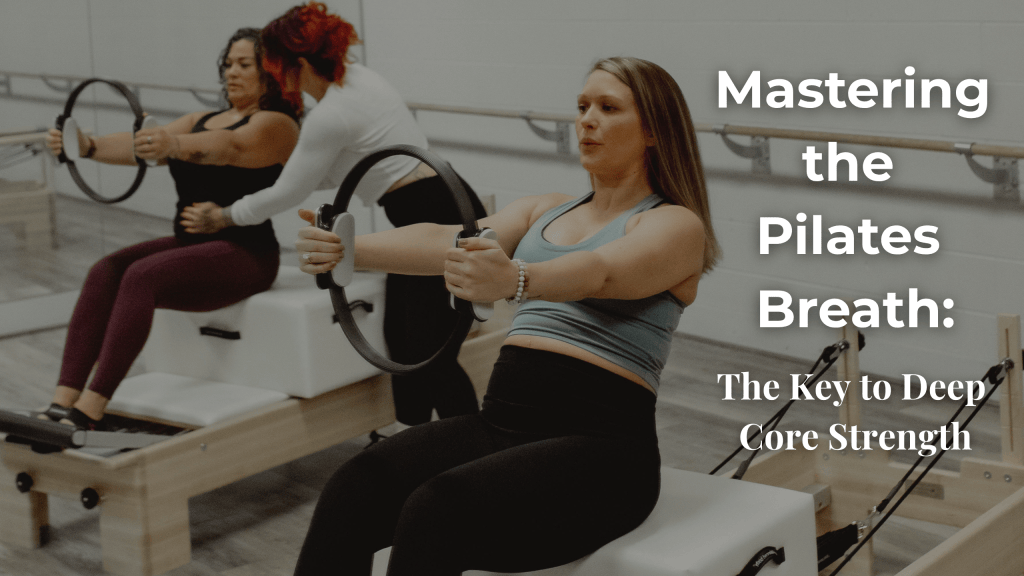
Breathing is something we do without thinking thousands of times a day, but when you step into a Pilates studio, breath takes on a whole new purpose. It isn’t just about getting air into your lungs, it’s the physical trigger that activates your body’s internal support system, aka, your core. Understanding why and how we breathe in Pilates helps you move with more power, protect your spine, and get far more out of every workout.
Why Is Activating Your Core So Important During Exercise?
Think of your core as the central bridge between your upper and lower body. Every time you pick up a weight, lift your leg, or curl your spine, physical force moves straight through your torso. When your core is properly engaged:
- It protects your back: It acts like a natural back brace, shielding your spine and joints from unnecessary strain.
- It improves your balance and form: A stable center gives your arms and legs a steady foundation to push and pull from, making movements feel smoother and more controlled.
- It prevents compensation: Without deep core support, outer muscles (like your lower back or hip flexors) have to overwork, which often leads to stiffness and aches over time.
Understanding Your Built-In Support: The “Core Canister”
To properly activate your core, it helps to change how you visualize it. In traditional fitness, people often think of the core as just the “six-pack” muscles on the front of the belly. However, modern movement science and physical therapy view the core as a 3D, pressure-regulated cylinder known as the “Core Canister.”
Instead of a flat set of abs, picture a canister made up of four interconnected walls:
- The Roof: Your diaphragm, which is your primary breathing muscle sitting under your ribs.
- The Floor: Your pelvic floor muscles, supporting you from below.
- The Front & Sides: Deep corset abdominals (transversus abdominis) wrapping horizontally around your waist.
- The Back: Deep spinal muscles (multifidus) running along your vertebrae.
Imagine an unopened soda can. When intact, its internal pressure allows it to easily withstand weight pressed on top of it. But if one side of that can is dented or weak, the whole structure collapses under pressure. Your body works the exact same way. True spinal stability requires all four sides of your core canister working together in harmony.
Why Breath is the Fuel for Core Stability
Your breath is the physical mechanism that regulates pressure inside that canister. Breathing isn’t separate from core work, it actively drives it:
- Oxygenating Your Muscles: During exertion, your muscles demand a steady flow of oxygen to produce energy and prevent premature fatigue.
- Regulating Pressure Safely: Holding your breath during a tough movement creates unsafe, unmanaged pressure in your abdomen. This trapped pressure pushes down on your pelvic floor or strains your lower back.
- Automatic Engagement: When you exhale thoughtfully, your diaphragm lifts, your pelvic floor gently draws up, and your deep corset muscle automatically tightens around your spine. A well-timed exhale gives you maximum stability right at the most challenging point of a movement.
What is “Lateral Breathing” (and What Does “Breathing Sideways” Mean)?
In belly breathing (often taught in yoga), you let your stomach expand outward on every inhale. But in Pilates, if your belly expands completely outward, you lose support in your lower back while performing hard movements.
Instead, Joseph Pilates taught lateral thoracic (3D) breathing. This type of breathing is when you “direct your breath sideways.” Picture your ribcage as an accordion or an umbrella:
- When you inhale, your belly stays lightly contained, and you expand your breath outward into the sides and back of your ribs.
- You should actually feel your ribs physically push out toward the sides of the room and back into the mat!
- This gives your lungs full room to take in oxygen without turning off your deep abdominal muscles.
How Joseph Pilates Intended Us to Breathe
Joseph Pilates was famously strict about breath execution, viewing full respiration as a “physical housecleaning” that flushed out stagnant air and revitalized the bloodstream.
Here are his core rules for breath technique:
- Full Exhalation: Joseph emphasized wringing out the lungs completely, like squeezing water out of a wet sponge. He believed you couldn’t take a full, refreshing inhale until you completely emptied your lungs first.
- Breathing on Rhythm: He designed every single movement to pair with a specific, continuous rhythm, never forced or fast, but steady and fluid.
- Inhale Through the Nose, Exhale Through the Mouth: Inhaling through the nose filters and warms the air, while exhaling gently through pursed lips (like blowing out candles) helps activate those deep corset muscles.
Try This in Your Next Class
- Wrap your hands around your ribs: Place your hands on the sides of your ribcage. Inhale and try to expand your hands outward sideways without letting your belly pop up.
- Exhale to move: Use your exhale during the hardest part of an exercise (like curling up or pressing out) to naturally switch on your core.
- Keep the air moving: Never hold your breath! If a move feels difficult, that is your cue to exhale deeper and wring out your lungs.
Connecting It All On the Mat
The next time you are on the reformer or mat, remember that you aren’t just breathing, you are engaging an entire 3D support system designed to keep you strong, balanced, and pain-free. Give lateral 3D breathing a try during your next workout, and notice how much lighter, more supported, and more powerful your movements feel!
Sources:
Internal Teacher Training Manual, Redlands Barre & Pilates.
Pilates, Joseph H. Return to Life Through Contrology. Presentation Dynamics, 1945.