
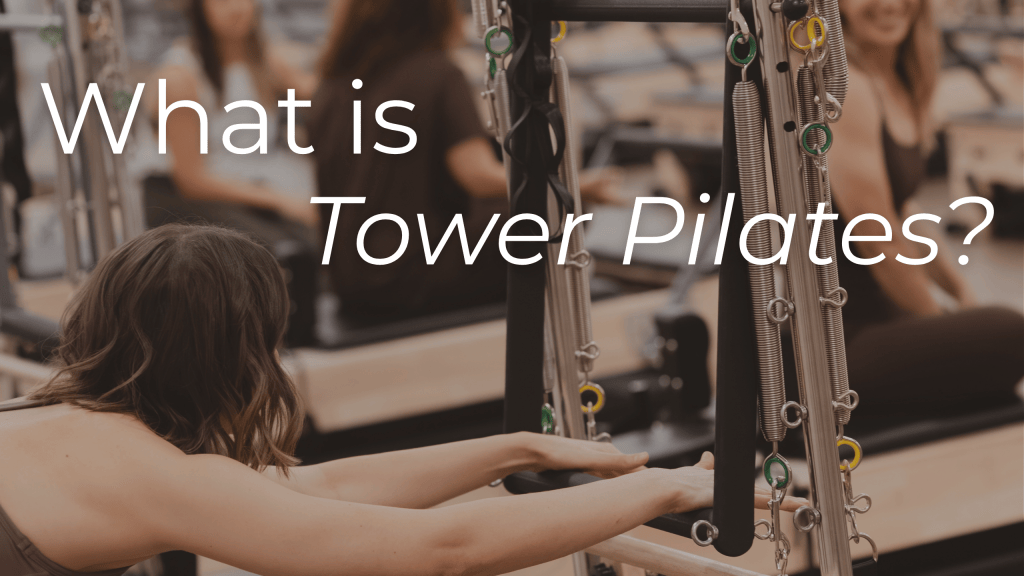
If you’re familiar with Reformer Pilates, you may have seen a vertical frame with springs attached to the end of a Reformer and wondered what it is. That’s the Pilates Tower, and it adds a unique combination of resistance, support and movement to your Pilates practice.
Tower Pilates combines the foundational principles of Pilates with spring resistance to create a full body workout that builds strength, improves mobility and challenges your stability and control.
The Story Behind the Tower
To understand the Tower, it helps to understand how Joseph Pilates developed his method in the first place. Joseph Pilates was an inventor as much as he was an instructor. He was constantly exploring how equipment could help the body move more effectively, using springs, resistance and support to create exercises that could be adapted to different bodies and needs.
During World War I, while interned on the Isle of Man, Pilates experimented with attaching springs to beds so that people who were unable to move easily could work against resistance while supported. These early experiments with springs and support became part of the foundation for the apparatus that would eventually develop into the Pilates equipment we know today.
Over time, Pilates continued developing his equipment and method. The larger apparatus became known as the Cadillac, or Trapeze Table, while the Tower evolved as a more streamlined version of the same spring based concept. Today, the Tower can be attached to the end of a Reformer, bringing many of these original spring based ideas into a modern studio setting.
The idea behind it remains simple: use resistance and support to help the body move with greater control, strength and precision.
What Makes Tower Pilates Different?
The Tower uses adjustable springs, bars and straps to provide both resistance and assistance throughout class. That means the springs can make an exercise more challenging, but they can also support you through a movement, help you access greater range of motion, or provide feedback that helps you understand how your body is moving. This versatility is what makes Tower work so interesting. You aren’t simply adding resistance to a Reformer workout. You are using the springs to change how your body experiences a movement.
What Can You Expect to Work On?
Strength
The springs provide adjustable resistance throughout a wide variety of movements, allowing you to challenge your muscles while maintaining control and precision.
Core Stability
Tower exercises often require you to stabilize your trunk while your arms and legs move independently. The springs can create resistance from different directions, asking your core to organize and stabilize the body.
Flexibility and Mobility
The Tower can assist the body through stretches and movements that might otherwise be difficult to access. Spring assistance can help you explore greater range of motion while maintaining control.
Posture and Alignment
Because the springs provide both resistance and feedback, they can help you become more aware of your body’s position. You’ll spend time focusing on alignment, stability and how different parts of your body work together.
Control and Coordination
The Tower encourages slow, intentional movement. Rather than relying on momentum, you’ll learn to control both the movement of your body and the tension of the springs.
Is Tower Pilates Right for You?
Tower Pilates can be a great option for both newer and experienced Pilates enthusiasts. The springs can be adjusted to provide more resistance, less resistance or additional support, making the exercises adaptable to different bodies and experience levels.
If you enjoy Reformer Pilates and want to explore more variety, strength, mobility and range of motion, Tower Pilates offers a different way to experience the method. And if you’re completely new to the Tower, don’t worry. You don’t need to know how to use the equipment before class. Your instructor will guide you through the springs, setup and movements throughout your workout.
Come ready to move, strengthen and discover a new dimension of your Pilates practice. We’ll see you in class!
Sources:
National Pilates Certification Program, History of Pilates
Pilates Intel, History of the Pilates Cadillac

